

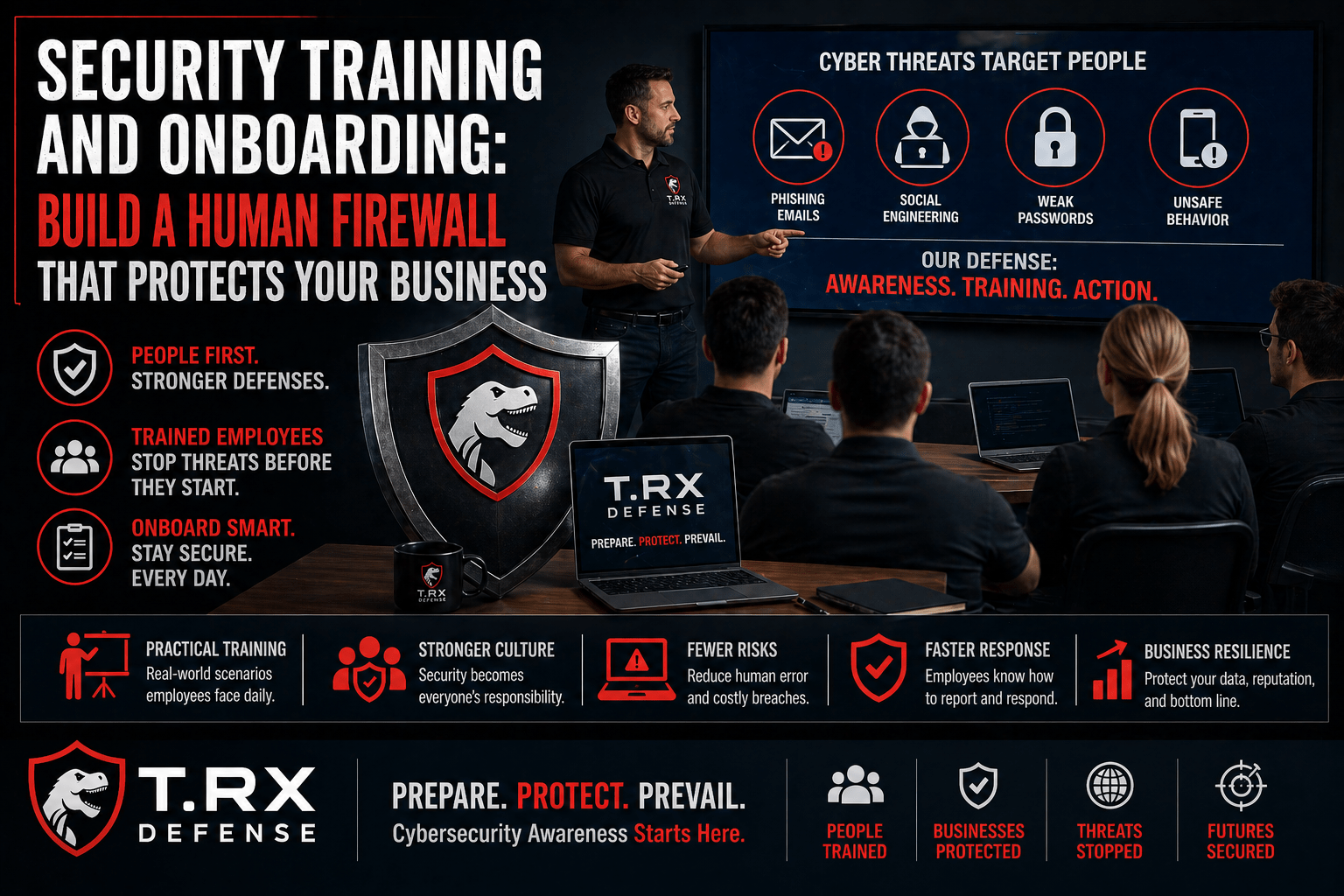
Security training and onboarding are no longer optional for modern businesses. Cybercriminals increasingly target employees through phishing, social engineering, credential theft, and human error because people are often easier to exploit than technology.
Many businesses invest heavily in firewalls, endpoint protection, and cloud security while overlooking one of the most important cybersecurity defenses they have: properly trained employees.
The reality is simple:
A company with strong technology and poor security awareness is still vulnerable.
At T.RX Defense, we help organizations build stronger cybersecurity cultures through practical security training and onboarding programs that help businesses Prepare, Protect, and Prevail against evolving threats.
Table of Contents
- Why Security Training and Onboarding Matter
- The Human Element in Cybersecurity
- Common Security Training Mistakes
- What Effective Security Onboarding Includes
- Why Ongoing Training Matters
- Building a Security-First Culture
- Final Thoughts
Why Security Training and Onboarding Matter
Security training and onboarding establish the foundation for how employees handle:
- Password security
- Phishing emails
- Sensitive data
- Device security
- MFA prompts
- Incident reporting
- Remote work security
- Social engineering attempts
Most employees are not cybersecurity experts.
Without proper guidance, people often make decisions based on convenience rather than security.
That creates opportunity for attackers.
According to Verizon’s Data Breach Investigations Report, the human element continues to play a role in the majority of security breaches.
Strong security training and onboarding reduce risk by helping employees:
- Recognize suspicious activity
- Follow security policies
- Understand reporting procedures
- Build safer habits
- Reduce accidental exposure
Good cybersecurity starts with awareness.
The Human Element in Cybersecurity
Cybercriminals target people because human behavior is predictable.
Attackers know employees:
- Work quickly
- Multitask constantly
- Trust familiar brands
- Respond to urgency
- Get distracted
- Reuse passwords
- Click before verifying
That’s why phishing and social engineering attacks remain so effective.
A single employee mistake can lead to:
- Ransomware infections
- Credential theft
- Business email compromise
- Financial fraud
- Data exposure
- Operational downtime
Many businesses assume employees “should know better,” but most organizations never provide meaningful security onboarding in the first place.
That’s a dangerous assumption.
Security awareness must be taught, reinforced, and maintained consistently.
Common Security Training Mistakes
Many organizations attempt security training once per year through generic compliance videos or checkbox exercises.
Unfortunately, attackers evolve much faster than outdated annual training programs.
Here are some of the most common mistakes businesses make with security training and onboarding.
1. Treating Security Training as a One-Time Event
Cybersecurity threats change constantly.
Employees need ongoing reinforcement, updated examples, and regular reminders to stay effective against evolving attacks.
One onboarding session five years ago does not prepare employees for:
- AI-generated phishing
- MFA fatigue attacks
- Deepfake scams
- Modern credential theft tactics
2. Overloading New Employees
Some businesses overwhelm employees during onboarding with:
- Dense policy documents
- Technical jargon
- Long compliance presentations
Most of it gets forgotten immediately.
Security onboarding works best when it is:
- Clear
- Practical
- Role-specific
- Easy to apply daily
3. Ignoring Real-World Scenarios
Employees learn best through realistic examples.
Training should include:
- Phishing simulations
- Suspicious email examples
- Social engineering scenarios
- Password security demonstrations
- Incident reporting exercises
Real-world context improves retention dramatically.
4. Failing to Explain “Why”
Employees are more likely to follow security procedures when they understand:
- How attacks happen
- Why policies exist
- What consequences breaches create
People support what they understand.
5. Punishing Employees for Reporting Mistakes
One of the worst cybersecurity cultures a company can create is fear-based reporting.
Employees should feel comfortable reporting:
- Suspicious emails
- Accidental clicks
- Potential mistakes
- Lost devices
- Security concerns
Early reporting often prevents small issues from becoming major incidents.
Explore proactive cybersecurity services here:
https://trxdefense.com/services
What Effective Security Onboarding Includes
Strong security training and onboarding programs should start immediately when employees join the organization.
New hires should understand security expectations before receiving broad access to systems and data.
A strong onboarding process often includes:
Password and MFA Best Practices
Employees should understand:
- Password manager usage
- MFA expectations
- Credential security
- Account protection policies
Phishing Awareness
Teach employees how to identify:
- Suspicious links
- Fake login pages
- Urgent requests
- Spoofed domains
- Unexpected attachments
Acceptable Use Policies
Clearly define:
- Device usage expectations
- Remote work policies
- Data handling procedures
- Software installation restrictions
Incident Reporting Procedures
Employees should know:
- Who to contact
- How to report suspicious activity
- What information to provide
- Why speed matters during incidents
Access Control Awareness
Users should understand:
- Least privilege access
- Why permissions matter
- Why shared accounts create risk
Good onboarding creates safer habits early.
Why Ongoing Training Matters
Cybersecurity awareness fades over time without reinforcement.
Employees forget procedures.
Threats evolve.
Bad habits return.
That’s why ongoing security training matters just as much as onboarding.
Effective organizations regularly provide:
- Refresher training
- Phishing simulations
- Security newsletters
- Threat awareness updates
- Role-specific education
- Incident review discussions
The goal is creating continuous awareness rather than annual compliance exercises.
Businesses with strong cybersecurity cultures often experience:
- Faster threat reporting
- Reduced phishing success rates
- Better policy compliance
- Lower ransomware risk
- Improved operational resilience
Find additional cybersecurity resources here:
https://trxdefense.com/resources
Building a Security-First Culture
The strongest cybersecurity programs are cultural — not just technical.
Employees should view cybersecurity as:
- Part of daily operations
- A shared responsibility
- An operational priority
- A business protection strategy
Leadership plays a major role here.
When executives ignore security procedures, employees usually follow their example.
Security culture improves when leadership:
- Supports training initiatives
- Follows policies consistently
- Encourages reporting
- Reinforces awareness
- Prioritizes preparation
Cybersecurity becomes far more effective when it is operationally normalized rather than treated like an inconvenience.
Security Awareness Is a Competitive Advantage
Businesses often think about cybersecurity only in terms of risk reduction.
But strong security training and onboarding also create operational advantages:
- Better compliance readiness
- Improved customer trust
- Reduced downtime
- Faster incident response
- Lower financial exposure
- Improved cyber insurance positioning
Prepared organizations recover faster and operate more confidently under pressure.
At T.RX Defense, we help businesses strengthen security awareness, improve onboarding procedures, and build practical cybersecurity strategies designed for real-world threats.
Final Thoughts
Technology alone cannot stop every cyberattack.
Employees remain one of the most targeted — and most important — parts of any cybersecurity strategy.
Strong security training and onboarding help businesses reduce human error, improve resilience, and create a stronger first line of defense against modern cyber threats.
One well-trained employee can stop an attack before it becomes a disaster.
Ready to strengthen your organization’s cybersecurity posture?
- Main Site: https://trxdefense.com
- Services: https://trxdefense.com/services
- Resources: https://trxdefense.com/resources
- Contact T.RX Defense: https://trxdefense.com/contact
T.RX Defense — Prepare. Protect. Prevail.