

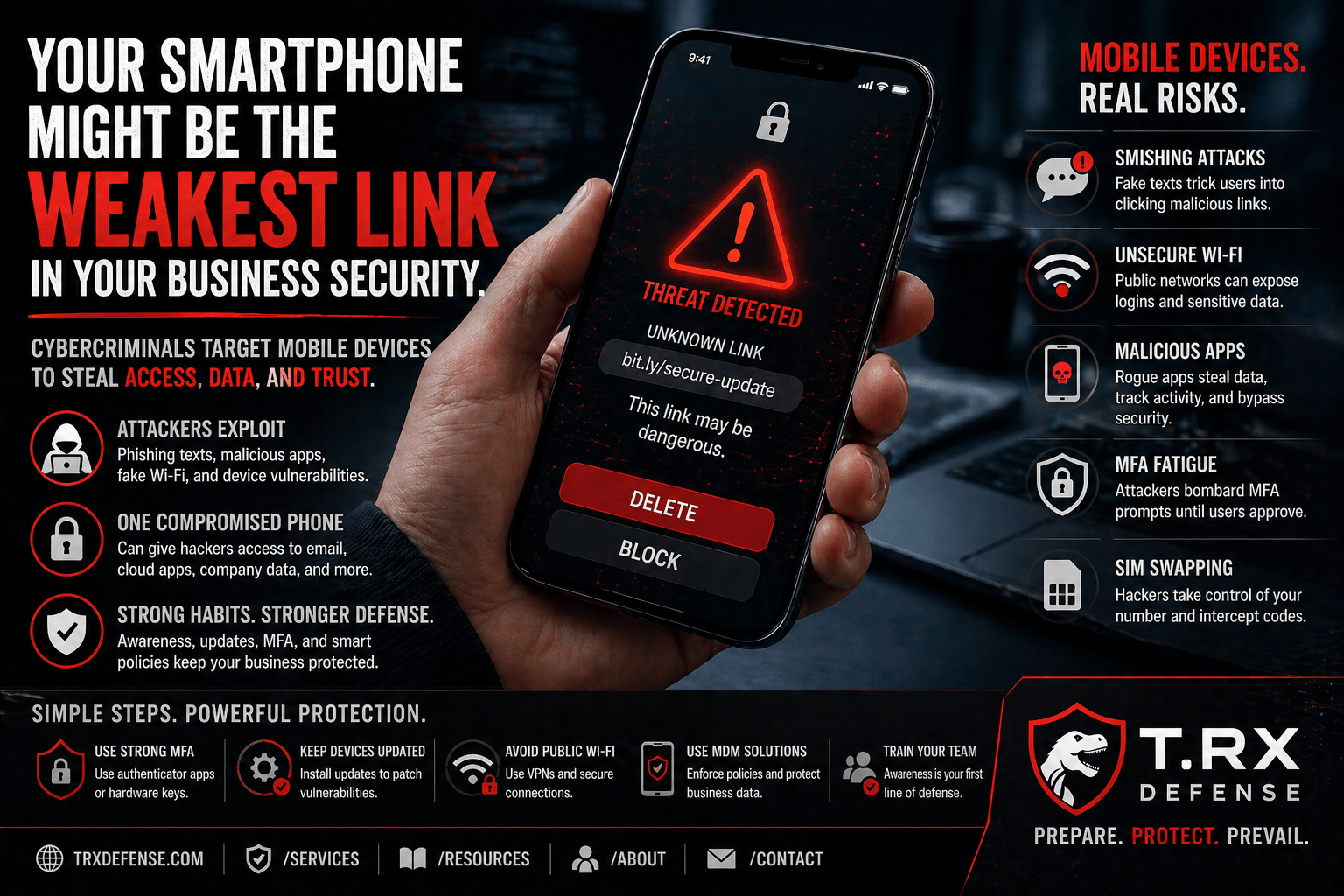
Most businesses spend time protecting laptops, servers, firewalls, and cloud platforms.
Meanwhile, one of the most overlooked cybersecurity risks is sitting in nearly every employee’s pocket.
Smartphones have become essential business tools. Employees use them to:
- Access company email
- Approve MFA requests
- Store sensitive documents
- Access cloud platforms
- Communicate with clients
- Manage banking and payment apps
The problem?
Cybercriminals know it.
Today, mobile devices are no longer secondary targets — they’re becoming primary entry points for attacks.
At T.RX Defense, we help businesses strengthen cybersecurity across every device employees use, including the phones they rely on every day.
Why Smartphones Are Attractive Targets
Many people still treat smartphones like personal devices instead of business-critical systems.
That creates dangerous habits:
- Clicking links without verifying them
- Connecting to public Wi-Fi
- Reusing passwords
- Ignoring software updates
- Installing unverified apps
- Mixing personal and business activity
Attackers understand that mobile users are often:
- Distracted
- Moving quickly
- Less cautious on smaller screens
- More likely to trust text messages and app notifications
That combination creates opportunity.
Smishing Attacks Are Exploding
“Smishing” — phishing through text messages — has become one of the fastest-growing attack methods.
These scams often impersonate:
- Banks
- Shipping companies
- Mobile carriers
- Microsoft or Google
- Executives or coworkers
- MFA alerts
Messages typically create urgency:
- “Your package is delayed”
- “Suspicious login detected”
- “Payment failed”
- “Verify your account immediately”
On mobile devices, shortened URLs and small screens make suspicious links harder to spot.
According to the FTC, scam text messages continue increasing dramatically every year.
MFA Can Become a Mobile Weakness
Many businesses rely heavily on smartphones for multi-factor authentication (MFA).
But attackers now target MFA directly through:
- MFA fatigue attacks
- SIM swapping
- Mobile malware
- Fake login pages
- Push notification abuse
If a phone becomes compromised, attackers may gain access to:
- Email accounts
- Cloud storage
- VPN access
- Password resets
- Business applications
One compromised phone can create organization-wide exposure.
Explore proactive cybersecurity solutions here:
https://trxdefense.com/services
Public Wi-Fi and Mobile Devices Are a Dangerous Combination
Employees frequently connect phones to:
- Airports
- Hotels
- Coffee shops
- Restaurants
- Event venues
Unsecured public networks create opportunities for:
- Credential interception
- Fake Wi-Fi networks
- Session hijacking
- Malware delivery
Cybercriminals often create fake hotspots with legitimate-looking names to trick users into connecting.
Once connected, attackers may monitor traffic or redirect victims to malicious login portals.
Mobile Apps Create Hidden Risks
Not all mobile apps are safe.
Some apps:
- Collect excessive permissions
- Contain hidden malware
- Harvest sensitive information
- Track user behavior
- Introduce software vulnerabilities
Even legitimate apps can become dangerous if compromised through third-party breaches or malicious updates.
Businesses should review:
- App permissions
- Device policies
- Mobile access controls
- Employee device usage policies
Find cybersecurity resources and best practices here:
https://trxdefense.com/resources
Small Security Habits Make a Big Difference
Businesses can dramatically improve mobile security with a few practical steps:
Enable Strong MFA
Use authenticator apps or hardware-based authentication whenever possible.
Keep Devices Updated
Software updates often patch critical vulnerabilities attackers actively exploit.
Use Mobile Device Management (MDM)
MDM solutions help enforce security policies and remotely wipe compromised devices.
Avoid Public Wi-Fi Without Protection
Use VPNs and avoid sensitive activity on unsecured networks.
Train Employees to Spot Mobile Scams
Awareness matters just as much on phones as it does on laptops.
Require Strong Screen Locks
Biometric authentication and strong passcodes reduce risk if devices are lost or stolen.
Smartphones Are Business Infrastructure Now
The line between personal technology and business infrastructure has disappeared.
Phones now hold:
- Sensitive conversations
- Client information
- Authentication tools
- Financial access
- Business communications
- Internal company data
That means smartphones deserve the same cybersecurity attention as any server or workstation.
At T.RX Defense, we help businesses strengthen mobile security, improve awareness, and reduce exposure to evolving cyber threats across every connected device.
Your Business Is Only as Secure as the Devices Connected to It
Cybercriminals are constantly searching for the easiest path into a business.
Increasingly, that path starts with a smartphone.
One malicious link.
One fake text.
One compromised app.
One distracted moment.
That’s all attackers may need.
Ready to strengthen your organization’s cybersecurity posture?
- Main Site: https://trxdefense.com
- Services: https://trxdefense.com/services
- Resources: https://trxdefense.com/resources
- Contact T.RX Defense: https://trxdefense.com/contact
T.RX Defense — Prepare. Protect. Prevail.