
For years, cybersecurity professionals told businesses the same thing:
Enable multi-factor authentication (MFA).
And for good reason.
MFA remains one of the most effective ways to prevent unauthorized account access, credential theft, and phishing-related compromises. According to Microsoft, MFA can block more than 99.9% of automated account compromise attacks.
But cybercriminals adapt quickly.
Today, attackers are increasingly targeting not just passwords — but the people behind MFA prompts themselves.
This growing tactic is known as MFA fatigue, and it’s becoming one of the fastest-growing identity attack methods businesses face.
At T.RX Defense, we help organizations strengthen account security while staying ahead of evolving attack techniques designed to bypass traditional defenses.
What Is MFA Fatigue?
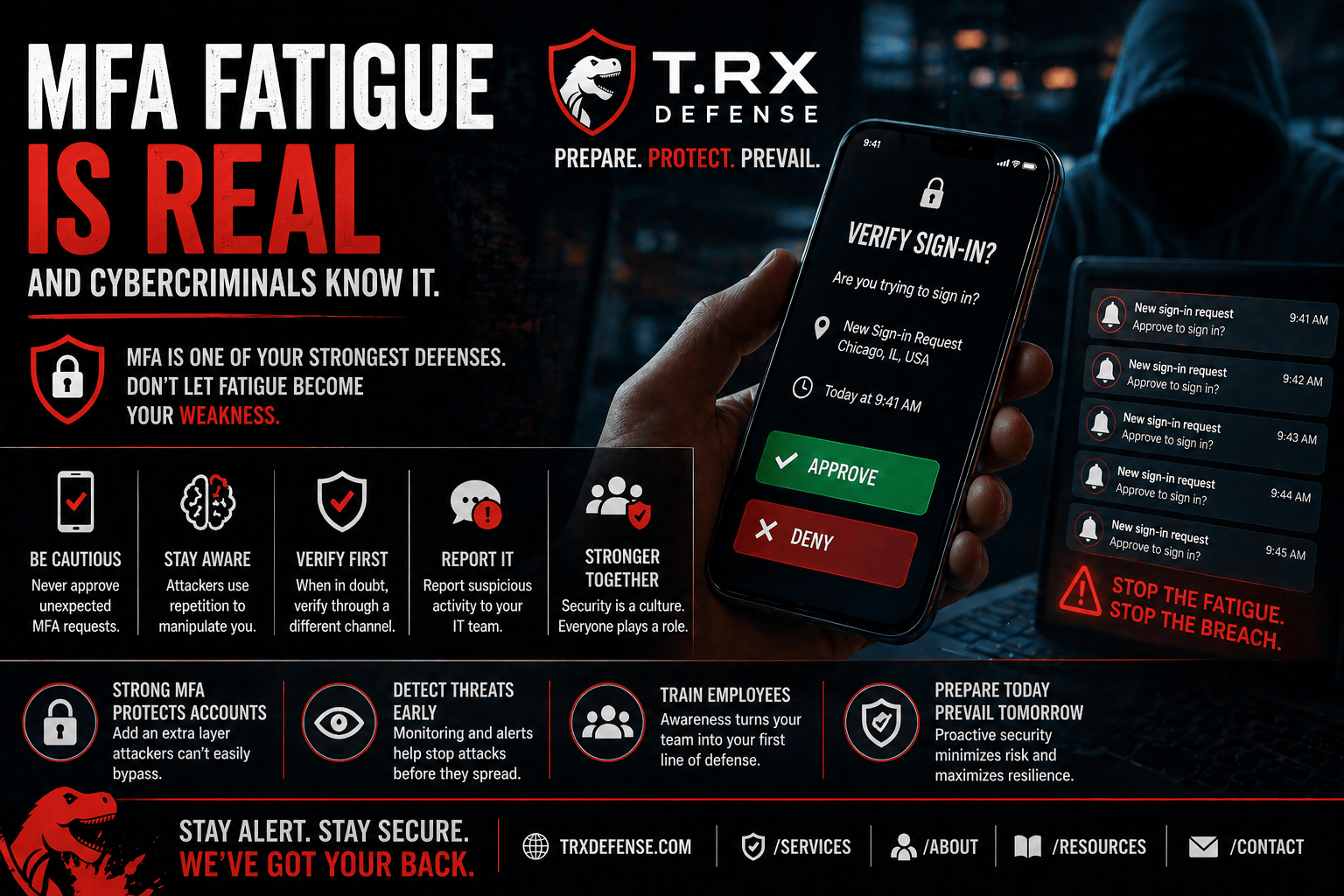
MFA fatigue attacks — sometimes called “push bombing” — occur when attackers repeatedly send authentication requests to a user’s device hoping they eventually approve one.
It usually starts with stolen credentials obtained through:
- Phishing emails
- Data breaches
- Password reuse
- Malware infections
- Credential stuffing attacks
Once attackers have a username and password, they attempt login after login, triggering repeated MFA approval notifications.
Eventually, users may:
- Accidentally approve the request
- Become annoyed and click “Accept”
- Assume the prompts are legitimate
- Panic and approve access to stop the notifications
That one approval can give attackers full access to business systems, email accounts, cloud platforms, or sensitive data.
Why MFA Fatigue Works So Well
The scary part about MFA fatigue is that it exploits human behavior — not technical weaknesses.
Attackers understand:
- People are distracted
- Employees multitask constantly
- Notifications blend together
- Users become desensitized
- Repetition creates confusion
Some attackers even combine MFA fatigue with social engineering tactics.
For example:
- Calling employees while prompts appear
- Pretending to be IT support
- Claiming systems require urgent verification
- Creating panic or urgency
The attack works because people naturally want interruptions to stop.
Cybercriminals know that eventually, many users will give in.
MFA Is Still Critical — But Configuration Matters
Here’s the important part:
MFA is absolutely still essential.
Businesses should not disable MFA because of fatigue attacks.
Instead, organizations need stronger MFA strategies and better employee awareness.
Effective MFA security should include:
- Number matching authentication
- App-based authenticators
- Geographic login monitoring
- Conditional access policies
- Device trust enforcement
- Login risk detection
Traditional “Approve/Deny” push notifications alone are becoming increasingly risky.
According to CISA, attackers continue evolving methods designed to bypass weak identity protections.
The Human Side of Cybersecurity Matters
Technology alone cannot solve MFA fatigue attacks.
Employees must understand:
- Never approve unexpected MFA prompts
- Report repeated login notifications immediately
- Be suspicious of urgent requests tied to authentication
- Verify IT requests independently
- Recognize phishing attempts early
Awareness training remains one of the strongest defenses against identity-based attacks.
The businesses most vulnerable to MFA fatigue are often the ones where employees feel pressured to “just click approve and move on.”
That mindset creates opportunity for attackers.
Explore proactive cybersecurity solutions here:
https://trxdefense.com/services
Passwords Alone Are No Longer Enough
The modern cybersecurity landscape revolves around identity protection.
Attackers increasingly target:
- User credentials
- Cloud logins
- Microsoft 365 accounts
- Remote access tools
- VPN access
- Administrative accounts
Why?
Because compromising one trusted identity often grants access to an entire network.
That’s why businesses should prioritize:
- Strong MFA policies
- Password managers
- Least privilege access
- Continuous monitoring
- Employee awareness training
Find additional cybersecurity resources here:
https://trxdefense.com/resources
MFA Fatigue Is a Warning Sign
MFA fatigue attacks highlight a bigger truth about cybersecurity:
Attackers no longer just target systems.
They target attention spans, habits, and human psychology.
Cybersecurity today is not just about firewalls and antivirus software.
It’s about protecting identities, reducing friction points, and building awareness across the organization.
At T.RX Defense, we help businesses strengthen identity security, improve resilience, and proactively defend against evolving cyber threats before they disrupt operations.
Don’t Let One Approval Become a Breach
One click.
One tap.
One distracted moment.
That’s sometimes all it takes for attackers to gain access.
MFA remains one of the most powerful cybersecurity defenses available — but only when paired with smart policies, modern protections, and employee awareness.
Ready to strengthen your organization’s security posture?
- Main Site: https://trxdefense.com
- Services: https://trxdefense.com/services
- Resources: https://trxdefense.com/resources
- Contact T.RX Defense: https://trxdefense.com/contact
T.RX Defense — Prepare. Protect. Prevail.