

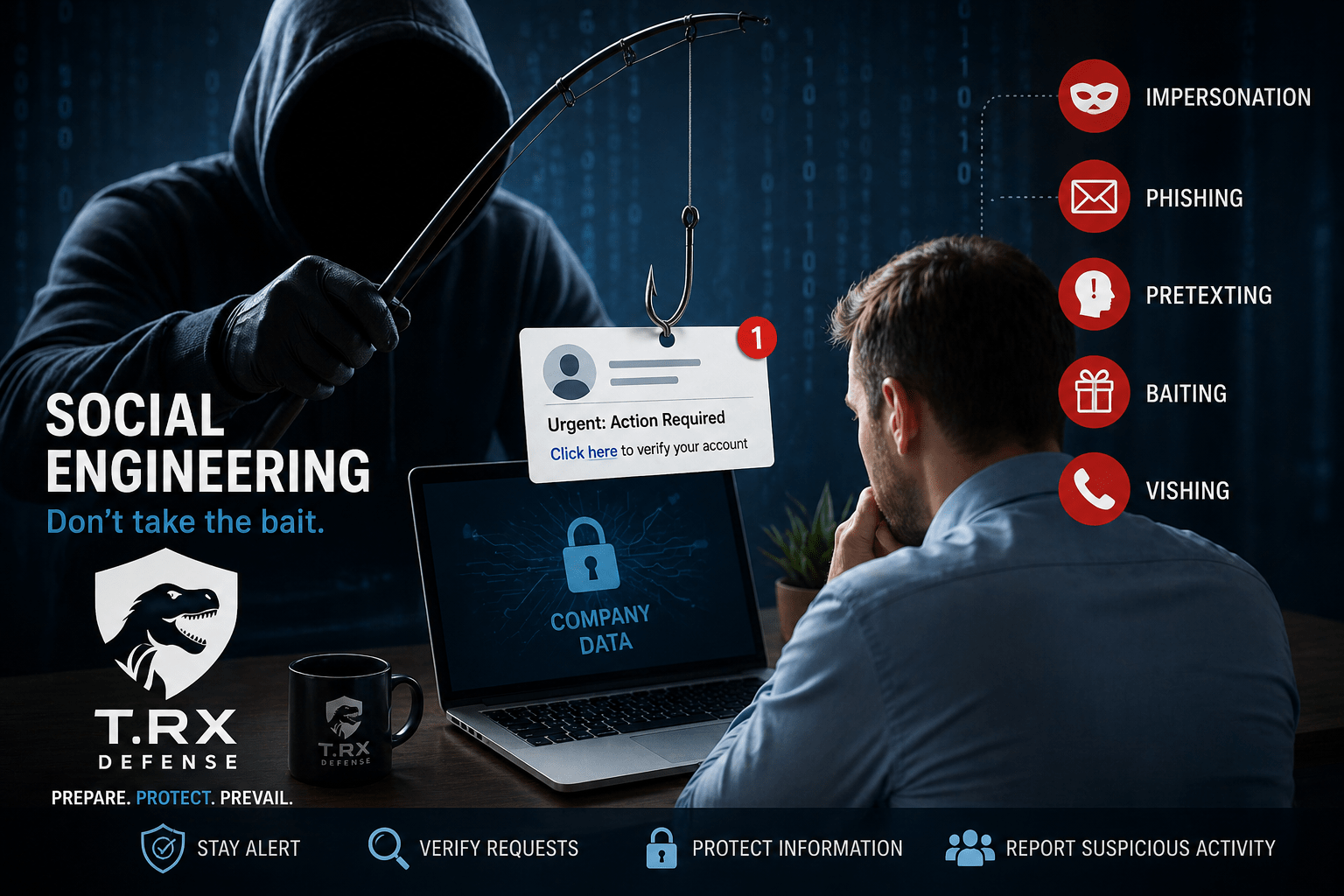
When businesses think about cybersecurity threats, they often picture malware, ransomware, or sophisticated hackers breaking through firewalls. But in reality, many cyberattacks start with something much simpler: manipulating people.
Social engineering attacks exploit trust, urgency, fear, or curiosity to trick employees into revealing sensitive information or granting unauthorized access. Instead of attacking systems directly, cybercriminals target human behavior — because it works.
At T.RX Defense, we help businesses strengthen both their technical defenses and their human firewall to better Prepare, Protect, and Prevail against evolving threats.
What Is Social Engineering?
Social engineering is the use of deception to manipulate individuals into bypassing normal security procedures.
Attackers commonly impersonate:
- IT support teams
- Company executives
- Vendors or suppliers
- Banks or financial institutions
- Shipping companies
- Government agencies
These attacks often arrive through:
- Email phishing
- Text messages (smishing)
- Phone calls (vishing)
- Social media messages
- Fake login pages
According to the FBI Internet Crime Complaint Center (IC3), phishing remains one of the most commonly reported cybercrimes affecting businesses and individuals alike.
Why Social Engineering Works
Social engineering attacks succeed because they create emotional pressure.
Attackers may:
- Create urgency (“Your account will be disabled immediately”)
- Use fear (“Your payroll information was compromised”)
- Exploit authority (“This is the CEO requesting payment”)
- Offer rewards (“You’ve won a gift card”)
Even experienced employees can make mistakes when caught off guard or distracted.
That’s why cybersecurity awareness training is critical for every organization — not just large enterprises.
Learn more about our cybersecurity services here:
https://trxdefense.com/services
Common Social Engineering Tactics
Phishing Emails
Fake emails designed to steal passwords, financial information, or install malware through malicious links or attachments.
Business Email Compromise (BEC)
Attackers impersonate executives or vendors to request wire transfers or sensitive data.
Pretexting
A scammer invents a believable story to convince someone to share confidential information.
Baiting
Offering something enticing — such as a free download or USB drive — to lure victims into compromising systems.
Impersonation
Pretending to be trusted personnel like IT staff, vendors, or management.
Small Security Habits That Make a Big Difference
Businesses can significantly reduce risk with a few practical habits:
- Verify unexpected requests through another communication channel
- Never click suspicious links without confirming legitimacy
- Use multi-factor authentication (MFA)
- Train employees regularly with simulated phishing tests
- Encourage employees to report suspicious activity immediately
The goal is to create a culture where employees feel comfortable slowing down and verifying unusual requests.
Visit our resource center for additional cybersecurity guidance:
https://trxdefense.com/resources
Your Employees Are Your First Line of Defense
Technology alone cannot stop every attack. Firewalls and antivirus software are important, but awareness and preparation remain essential.
Organizations that invest in employee training often detect threats faster and reduce the likelihood of successful attacks.
At T.RX Defense, we help businesses build stronger security awareness programs, improve internal policies, and strengthen overall cybersecurity posture.
Don’t Let Human Error Become a Security Breach
Social engineering attacks are constantly evolving, but preparation makes all the difference.
By combining employee awareness, strong security practices, and proactive cybersecurity planning, businesses can dramatically reduce their exposure to modern threats.
Ready to strengthen your organization’s defenses?
- Main Site: https://trxdefense.com
- Services: https://trxdefense.com/services
- Resources: https://trxdefense.com/resources
- Contact T.RX Defense: https://trxdefense.com/contact
T.RX Defense — Prepare. Protect. Prevail.